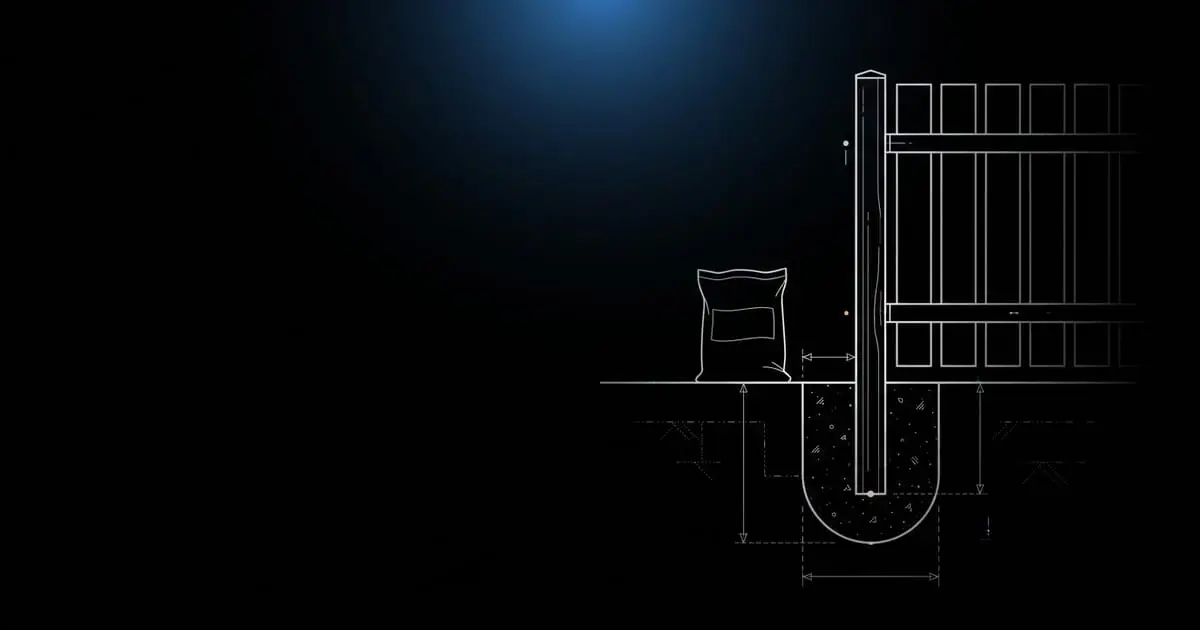
The concrete for a fence post is the volume of the hole minus the volume of the post. Most residential fence posts need 1 to 3 bags. Measure your hole, then use the chart or the Sonotube concrete calculator. A round hole is a cylinder, the same shape as a form tube.
Bags per fence post
Concrete only (post subtracted), rounded up per post, no waste. A 4x4 is 3.5 × 3.5 inches actual, a 6x6 is 5.5 × 5.5 inches.
| Post | Hole diameter | Concrete depth | Concrete | 50 lb bags | 60 lb bags | 80 lb bags |
|---|---|---|---|---|---|---|
| 2-3/8 in round steel | 6 in | 2 ft | 0.31 cu ft | 1 | 1 | 1 |
| 4x4 | 8 in | 2 ft | 0.53 cu ft | 2 | 2 | 1 |
| 4x4 | 8 in | 2.5 ft | 0.66 cu ft | 2 | 2 | 2 |
| 4x4 | 10 in | 2 ft | 0.92 cu ft | 3 | 3 | 2 |
| 4x4 | 10 in | 3 ft | 1.38 cu ft | 4 | 4 | 3 |
| 6x6 | 12 in | 3 ft | 1.73 cu ft | 5 | 4 | 3 |
| 6x6 | 12 in | 4 ft | 2.30 cu ft | 7 | 6 | 4 |
Yields used: 50 lb = 0.375 cu ft, 60 lb = 0.45 cu ft, 80 lb = 0.60 cu ft. Fast-setting mix is often sold in 50 lb bags. Check the yield printed on yours.
The math
- Hole volume (cu ft) = 3.1416 × (hole diameter in inches ÷ 24)² × concrete depth in feet.
- Post volume (cu ft) = post width × post depth (inches) × concrete depth (feet) × 12 ÷ 1,728.
- Concrete = hole minus post.
- Bags = concrete ÷ bag yield, rounded up.
Example: 4x4 in a 10 inch hole, 2 ft of concrete.
- Hole: 3.1416 × (10 ÷ 24)² × 2 = 1.091 cu ft
- Post: 3.5 × 3.5 × 2 × 12 ÷ 1,728 = 0.170 cu ft
- Concrete: 0.921 cu ft
- 50 lb bags: 0.921 ÷ 0.375 = 2.5, so 3 bags
The calculator does not subtract the post, so for a whole fence it gives a small overage, about the size of the waste allowance. For 10 posts in 10 inch holes, enter one row with 10 holes.
Whole fence: 10, 20 and 30 posts
4x4 posts in 10 inch holes with 2 ft of concrete (0.92 cu ft each), plus 10% waste:
| Posts | Concrete | 50 lb bags | 80 lb bags |
|---|---|---|---|
| 10 | 10.1 cu ft | 28 | 17 |
| 20 | 20.3 cu ft | 55 | 34 |
| 30 | 30.4 cu ft | 82 | 51 |
Hole size and depth
- Width. A common rule of thumb is a hole about three times the post width: around 10 inches for a 4x4 and 12 or more for a 6x6. Wider holes use more concrete without much gain.
- Depth. A common guideline is one third to one half of the post height above ground, deeper for gate posts and tall privacy fences, and below the frost line where frost heave lifts posts.
- Gravel. Many installers put a few inches of gravel in the bottom for drainage. Measure concrete depth from the top of the gravel.
Fast-setting or regular mix?
Setting a fence post step by step
- Mark the line. Run a string between the end posts and mark each post position along it.
- Dig. Use a post-hole digger or auger to the depth and width you planned. Keep the sides straight so the concrete forms a neat column.
- Drainage. Add a few inches of gravel if you use it, and tamp it.
- Set the post. Stand the post on the gravel, check plumb on two faces, and brace it with two stakes.
- Fill. Add mixed concrete, or dry fast-setting mix followed by water, up to just below grade.
- Shape the top. Slope the concrete away from the post so water runs off instead of pooling against the wood.
- Check again. Re-check plumb and the string line before the concrete stiffens.
Gate posts need more
Gate posts carry the swinging weight of the gate, so they usually get a wider and deeper hole than line posts. For example, a 4x4 gate post in a 12 inch hole with 3.5 ft of concrete holds about 2.75 cu ft minus the post (0.30 cu ft), roughly 2.45 cu ft: 7 bags of 50 lb or 5 bags of 80 lb. Many builders also go up to a 6x6 for wide or heavy gates.
Common mistakes
- Holes much wider than needed, which doubles the concrete without making the post much stronger.
- Concrete mounded up against the post instead of sloped away.
- No brace, so the post drifts out of plumb while the concrete sets.
- Mixing in the hole with regular concrete mix, which leaves dry pockets.
Steel and round posts
Chain-link and some farm fences use round steel posts. They displace less concrete than wood, so the hole volume is almost all concrete. A 2-3/8 inch line post in a 6 inch hole with 2 ft of concrete takes about 0.31 cu ft, one bag of any size. Terminal and gate posts are larger, often 2-7/8 inches or more, and usually sit in wider, deeper holes. Use the hole diameter and depth in the calculator and subtract nothing; the post volume is small enough to fall inside the waste allowance.
Fast-setting mix can go into the hole dry and then be soaked with water, and the manufacturer rates it to set in about 20 to 40 minutes. Regular concrete mix is mixed first and gives you more working time. The trade-offs are in can you pour dry concrete in a post hole.