By Ashish · Updated · Formulas checked against the methodology
Quick answer: concrete for one Sonotube (cu ft) = 3.1416 × (diameter in inches ÷ 24)² × height in feet. A 12 inch tube 4 ft tall takes 3.14 cu ft, which is 6 bags of 80 lb or 7 bags of 60 lb concrete mix. Four of them with 10% waste need 13.82 cu ft, or 24 bags of 80 lb.
How to Calculate Concrete for a Sonotube
A Sonotube is a cylinder, so the concrete inside it is the area of the circle times the height. The only trap is units: tube sizes are sold in inches, heights are measured in feet, and concrete is sold by the bag or the cubic yard. Here is the method in four steps.
- Measure the tube and the pour. Use the tube's inside diameter (the size on the label) and the height of the concrete, from the bottom of the hole to the top of the pour. Include the part that sticks out above the ground.
- Work out the volume. Divide the diameter by 24 to get the radius in feet, square it, multiply by 3.1416 and by the height in feet. The answer is in cubic feet.
- Add footings, multiply, add waste. Add the volume of any bell or pad under the tube, multiply by the number of tubes, then add about 10% for spills and holes that come out wider than planned.
- Convert to bags or yards. Divide by the bag yield (0.60 cu ft for an 80 lb bag) and round up, or divide by 27 for cubic yards.
Worked example
A deck needs four 12 inch tubes, each with 4 ft of concrete.
- Radius: 12 ÷ 24 = 0.5 ft
- One tube: 3.1416 × 0.5² × 4 = 3.14 cu ft
- Four tubes: 3.14 × 4 = 12.57 cu ft (0.465 cu yd)
- With 10% waste: 12.57 × 1.10 = 13.82 cu ft
- 80 lb bags: 13.82 ÷ 0.60 = 23.0, so buy 24 bags
These are the default values in the calculator above, so you can check the math yourself.
How Many Bags of Concrete per Sonotube (Chart)
The first table shows how much concrete each tube size holds per foot of height, and how many bags a 4 ft tube takes. Bag counts are rounded up, with no waste added.
| Tube | cu ft per ft | cu yd per ft | 40 lb bags (4 ft) | 50 lb bags (4 ft) | 60 lb bags (4 ft) | 80 lb bags (4 ft) |
|---|---|---|---|---|---|---|
| 6 in | 0.196 | 0.0073 | 3 | 3 | 2 | 2 |
| 8 in | 0.349 | 0.0129 | 5 | 4 | 4 | 3 |
| 10 in | 0.545 | 0.0202 | 8 | 6 | 5 | 4 |
| 12 in | 0.785 | 0.0291 | 11 | 9 | 7 | 6 |
| 14 in | 1.069 | 0.0396 | 15 | 12 | 10 | 8 |
| 16 in | 1.396 | 0.0517 | 19 | 15 | 13 | 10 |
| 18 in | 1.767 | 0.0654 | 24 | 19 | 16 | 12 |
| 20 in | 2.182 | 0.0808 | 30 | 24 | 20 | 15 |
| 24 in | 3.142 | 0.1164 | 42 | 34 | 28 | 21 |
| 30 in | 4.909 | 0.1818 | 66 | 53 | 44 | 33 |
| 36 in | 7.069 | 0.2618 | 95 | 76 | 63 | 48 |
| 48 in | 12.566 | 0.4654 | 168 | 135 | 112 | 84 |
For other heights, this table gives 80 lb bags per tube for the most common deck and porch sizes:
| Tube | 2 ft | 3 ft | 4 ft | 5 ft | 6 ft |
|---|---|---|---|---|---|
| 8 in | 2 | 2 | 3 | 3 | 4 |
| 10 in | 2 | 3 | 4 | 5 | 6 |
| 12 in | 3 | 4 | 6 | 7 | 8 |
| 14 in | 4 | 6 | 8 | 9 | 11 |
| 16 in | 5 | 7 | 10 | 12 | 14 |
| 18 in | 6 | 9 | 12 | 15 | 18 |
| 24 in | 11 | 16 | 21 | 27 | 32 |
Bag yields used: 40 lb = 0.3 cu ft, 50 lb = 0.375 cu ft, 60 lb = 0.45 cu ft, 80 lb = 0.6 cu ft. These are the yields printed for standard concrete mix. High-strength and fast-setting mixes can differ slightly, so check the bag.
Sonotube Sizes and What They Are Used For
Form tubes are sold by inside diameter, usually in 4, 8 and 12 ft lengths, and you cut them to the height you need. The right diameter depends on the load and on what your plans or local code call for. As a rough guide:
| Diameter | Typical use |
|---|---|
| 6 to 8 in | Fence posts, mailbox posts, light sign posts, small landings |
| 10 to 12 in | Deck footings for 4x4 and 6x6 posts, small porches and sheds |
| 14 to 18 in | Larger decks, pergolas, carports, posts carrying heavy beams |
| 20 to 24 in | Pole barns, heavy porches, columns with large loads |
| 30 in and up | Structural columns and piers designed by an engineer |
Footing size for a deck is set by the load each post carries and by your soil. Your deck plan or building department has the final word.
Bell Footings and Pads
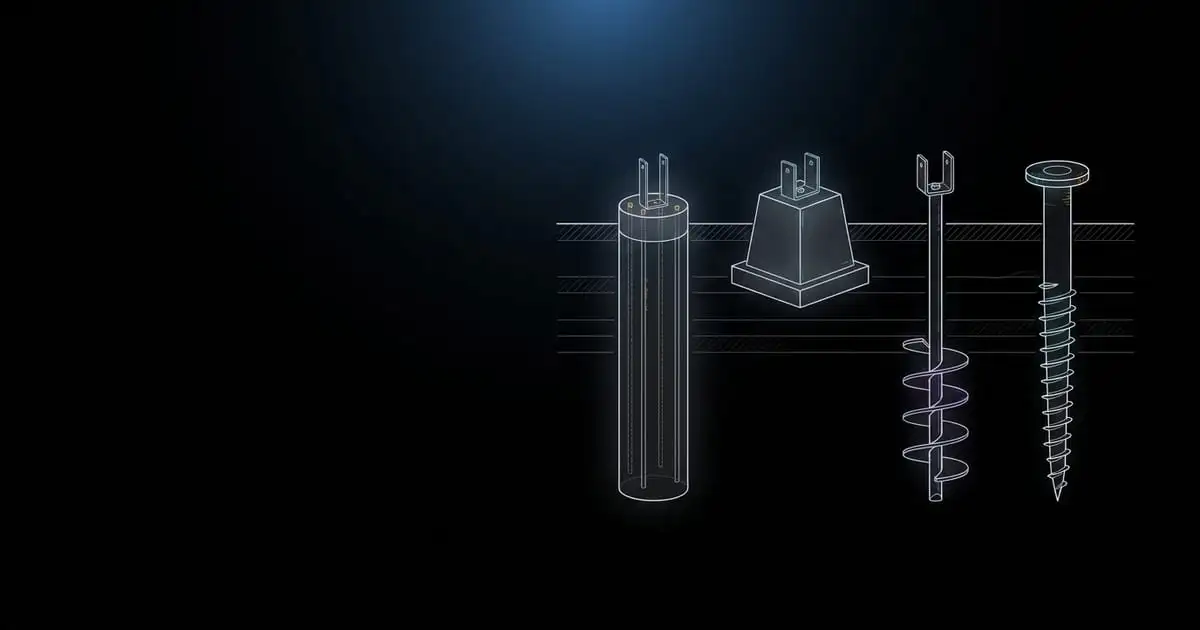
A straight tube spreads the load only over its own small circle. Many plans add a wider base at the bottom: either a bell (a plastic flared form that clips onto the tube) or a square pad poured first. Both add concrete, and it is easy to forget them when buying bags.
- Bell: a frustum. A bell from 12 in to 24 in over 12 in of height adds 1.83 cu ft per tube, about 4 extra bags of 80 lb.
- Pad: length × width × thickness. A 24 × 24 × 8 in pad adds 2.67 cu ft per tube.
Choose the footing type for each tube set in the calculator and it adds the volume for you.
Bags or Ready-Mix?
One cubic yard is 27 cu ft, or 45 bags of 80 lb. Mixing 45 bags by hand is a long day. Below that, bags almost always win on price and convenience. Above it, get a ready-mix quote, but ask about the minimum order and the short-load fee, which can make a small truck delivery cost more than the concrete itself.
Enter your bag price, the ready-mix price per yard and any short-load fee in step 3 of the calculator. It rounds the truck order up to the nearest quarter yard, the way suppliers sell it, and tells you which option is cheaper.
FAQ
How much concrete do I need for a Sonotube?
Multiply the tube's cross-section area by the height: volume (cu ft) = 3.1416 × (diameter in inches ÷ 24)² × height in feet. A 12 inch tube 4 ft tall holds 3.14 cu ft, which is 0.116 cubic yards or 6 bags of 80 lb concrete mix. Add about 10% for waste.
How many bags of concrete for a 12 inch Sonotube?
A 12 inch tube holds 0.785 cu ft per foot of height. For a 4 ft tube that is 3.14 cu ft: 6 bags of 80 lb, 7 bags of 60 lb, 9 bags of 50 lb or 11 bags of 40 lb, before waste.
How many bags of concrete for an 8 inch Sonotube?
An 8 inch tube holds 0.349 cu ft per foot. A 4 ft tube needs 1.40 cu ft, which is 3 bags of 80 lb or 4 bags of 60 lb concrete mix.
How many bags of concrete for a 16 inch Sonotube?
A 16 inch tube holds 1.396 cu ft per foot. A 4 ft tube needs 5.59 cu ft, or 10 bags of 80 lb (13 bags of 60 lb). At that size, compare the price of a small ready-mix load if you have several tubes.
How many bags of concrete for a 10 inch Sonotube?
A 10 inch tube holds 0.545 cu ft per foot. A 4 ft tube needs 2.18 cu ft: 4 bags of 80 lb or 5 bags of 60 lb concrete mix.
How many bags of concrete for an 18 inch Sonotube?
An 18 inch tube holds 1.767 cu ft per foot. A 4 ft tube needs 7.07 cu ft: 12 bags of 80 lb or 16 bags of 60 lb. Several of them add up fast, so price ready-mix too.
What size Sonotube for a 6x6 post?
Usually 10 or 12 inches. A 6x6 is 5.5 inches square with a 7.8 inch diagonal, so 8 inches is the smallest tube that fits, but bigger tubes leave room for the post base. The load may also call for a bell or pad underneath. See the guide on Sonotube size for 6x6 posts.
How do you cut a Sonotube?
Wrap a straight sheet of paper around the tube to mark a square line, then cut along it with a fine-tooth handsaw or jigsaw while turning the tube. After the pour, score the cardboard above grade with a utility knife and peel it off.
How deep should a Sonotube footing be?
The bottom of the footing must sit below your local frost line, and on firm undisturbed soil. Frost depth runs from almost nothing in the far south of the US to 48 inches or more in northern states. Your local building department sets the number, so check it before you dig.
Do you remove the Sonotube after the concrete sets?
The part below ground is normally left in place. The part above ground can be peeled off once the concrete has hardened, usually after a few days, for a cleaner look. Score the tube with a utility knife and pull it away in strips.
Should I use bags or order ready-mix for Sonotubes?
For a handful of deck footings, bags are usually cheaper and easier. Once a job reaches about a cubic yard (45 bags of 80 lb), a ready-mix truck is worth pricing, but small loads often carry a short-load fee. Enter both prices in the calculator to see which is cheaper for your job.
How do I calculate concrete for a bell footing?
A bell is a cone with its top cut off (a frustum). Its volume is 3.1416 × h ÷ 3 × (R² + R × r + r²), where R and r are the bottom and top radii and h is the bell height, all in feet. A bell that flares from 12 inches to 24 inches over 12 inches of height adds 1.83 cu ft per tube. Pick "Bell" in the calculator to add it automatically.
What is a Sonotube?
Sonotube is a brand name (made by Sonoco) for a round cardboard form used to pour concrete columns and footings. The generic name is a concrete form tube. Other makers sell the same product, and this calculator works for any round form.