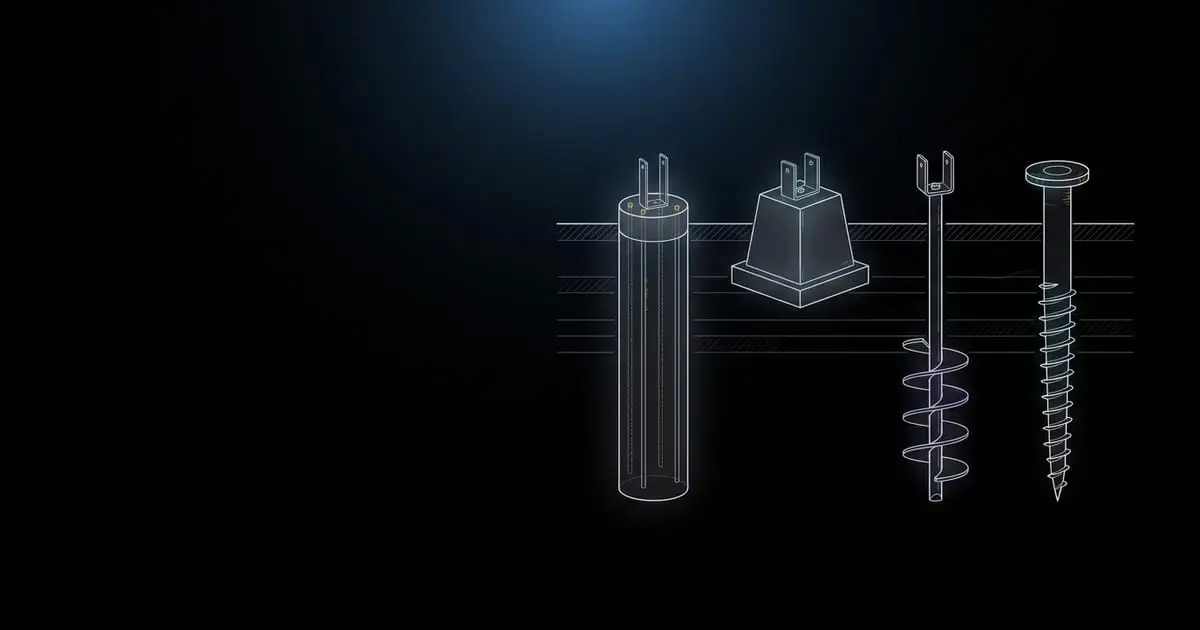
Every deck needs something between the frame and the soil. The four common choices differ in cost, labor and where the code allows them. If you choose poured footings, the Sonotube concrete calculator prices the concrete.
The four options at a glance
| Compare | Poured footing in a form tube | Precast pier block | Helical pier | Ground screw |
|---|---|---|---|---|
| What it is | Concrete column poured in a cardboard or plastic tube | Concrete block set on the ground | Steel shaft with helix plates, torqued into the soil | Threaded steel post driven in by hand or machine |
| Below frost line | Yes | No | Yes | Depends on length |
| Code acceptance | Everywhere | Only small freestanding decks under the IRC exception | Usually, with manufacturer data | Varies; ask first |
| Labor | Dig, set, mix, pour, wait | Level and place | Installer with a machine | Rental driver or installer |
| Wait before building | Concrete cure | None | None | None |
| Works on poor soil | With a bigger base | Poorly | Yes, rated by installation torque | Varies |
Poured footings in form tubes
This is the default because it handles any frost depth and every inspector knows it. Material cost is mostly bags of concrete and the tubes. Six 12 inch footings at 4 ft take 35 bags of 80 lb mix with 10% waste. The downside is labor: digging, mixing and waiting for the concrete to cure. See Sonotube footing detail and how to pour deck footings.
Precast pier blocks
Pier blocks sit on the surface or in a shallow bed of gravel. The 2021 IRC lets you skip footings only for freestanding decks of 200 sq ft or less, with joists bearing directly on precast pier blocks at grade (no posts or beams), and a walking surface no more than 20 inches above grade within 36 inches of the edge. Outside that, most inspectors will not accept them. More in concrete pier blocks for decks.
Helical piers
A helical pier is a steel shaft with one or more helix plates, turned into the ground by a machine until it reaches a set torque. That torque gives the load capacity. Helical piers go below the frost line, work on soft soil, and you can build on them the same day. They cost more than concrete for a typical deck and need an installer. Inspectors usually accept them as an approved structural system if you provide the manufacturer’s data.
Ground screws
Ground screws look like giant lag screws with a post bracket on top. They are fast and leave no concrete in the yard. Acceptance for decks varies widely, so get approval first and ask what documentation the inspector wants.
How to choose
- Attached deck in a frost area? Poured footings or helical piers.
- Small, low, freestanding deck that meets the exception? Pier blocks can work.
- Poor or wet soil? Helical piers, or poured footings with an engineer’s design.
- Lowest cash cost and you have time? Poured footings with bagged concrete.
Cost check for poured footings
Comparing cost the right way
Comparing the price of one item is misleading. Compare the full cost per footing:
| Cost item | Poured footing | Pier block | Helical pier |
|---|---|---|---|
| Material | Concrete, tube, post base | Block, gravel | Pier and bracket |
| Tools | Digger, mixer | Shovel, level | Installer’s machine |
| Labor | Dig, set, pour, wait | Level and place | Installer, quick |
| Hidden costs | Hauling spoil, waiting for cure | Rework if not allowed | Minimum job charge |
For poured footings, the calculator gives the concrete cost. Add the tubes and post bases from your store’s prices, then compare with a helical pier quote that includes installation.
Questions to ask your inspector
- Which footing systems do you accept for an attached deck?
- What documents do you need for helical piers or ground screws?
- Do you accept precast pier blocks for a freestanding deck under 200 sq ft?
- What frost depth applies?
Sloped yards
On a slope, poured footings in form tubes handle the height change easily: the downhill tubes are simply longer, or posts above them are taller. Helical piers also work well because the installer sets each one to depth regardless of the grade. Pier blocks on a slope need a lot of leveling and rarely meet the exception’s height limit on the downhill side.
Frost and freestanding decks
Footing choice also depends on whether the deck is attached. Under the base 2021 IRC, frost protection (R507.3.3) applies when the deck is attached to a frost-protected structure, because the house does not move with the frost and the deck would. A freestanding deck can move a little without damage, which is why the code allows pier blocks for small low ones. Many jurisdictions still require frost-depth footings for every deck, so check.
Removability
Pier blocks and ground screws can be removed when a deck comes out. Helical piers can sometimes be backed out by the installer. Poured concrete footings stay in the ground unless you dig them out, which matters if you might move or rebuild the deck later.
Quick answers
- Most widely accepted: poured concrete footings in form tubes.
- Fastest to build on: helical piers and ground screws, with no cure time.
- Cheapest for a small freestanding deck: precast pier blocks, where the code exception applies.
- Best on poor soil: helical piers, or an engineered poured footing.
Enter your bag price in step 3 of the calculator. At $6.50 a bag, six 12 inch footings at 4 ft with 10% waste come to 35 bags, about $228 in concrete before tubes and post bases. Open that example and change the price to yours.