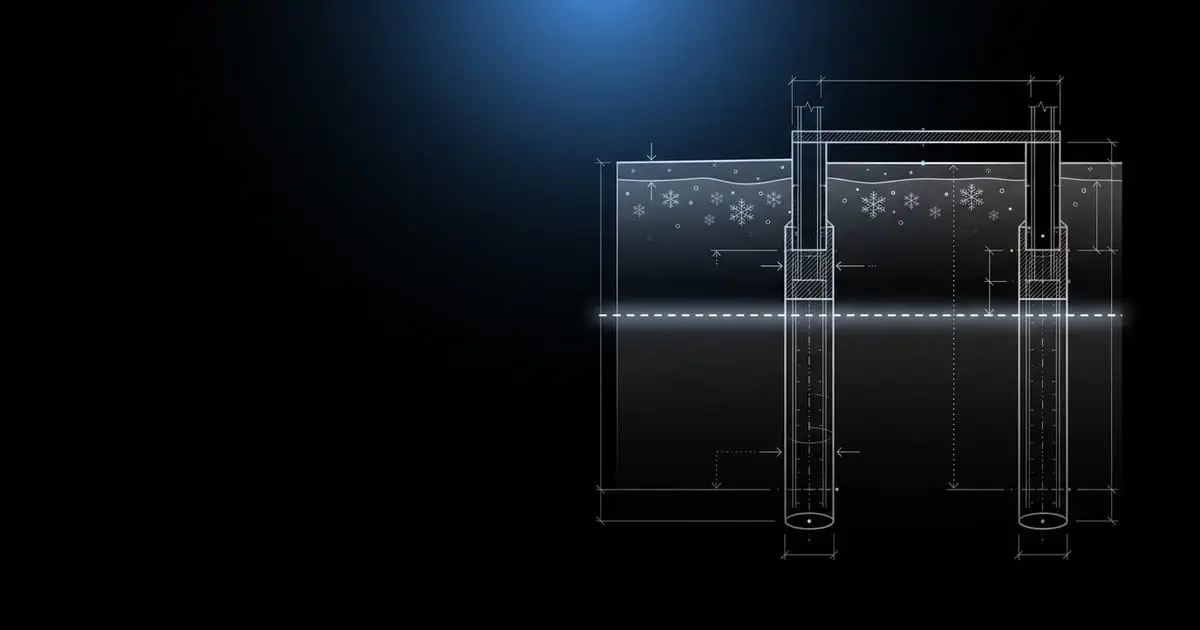
The frost line is the depth the ground freezes to in a hard winter. Footings that stop above it can be lifted when the wet soil under them freezes and expands. That is why your local code sets a minimum footing depth, and why the depth you dig decides how many bags you buy. Plug your depth into the Sonotube concrete calculator to see the effect.
Who sets the frost line depth
The IRC does not print one national number. Each jurisdiction fills in its frost depth in the climate table it adopts (Table R301.2 in the IRC), and the building department enforces it. A few examples of how this looks in practice:
| Place | Footing depth for frost | Source |
|---|---|---|
| Minnesota, Zone I (north) | 5 ft | Minnesota Rules 1303.1600 |
| Minnesota, Zone II (south) | 3.5 ft | Minnesota Rules 1303.1600 |
| Michigan | Set by the building official based on local conditions | Michigan building code rules |
| Any IRC deck | At least 12 in below undisturbed ground | IRC R507.3.2 |
Broad pattern across the US: the deepest requirements are in the northern tier and the mountains, the middle of the country falls between the extremes, and much of the Gulf Coast and Southwest have shallow or no frost depth. Treat that as a starting point, not an answer. Two towns in the same state can have different numbers.
How to find your number
- Search “[your city or county] building department deck handout”. Most deck handouts state the frost depth on the first page.
- If there is no handout, call the permit desk and ask “What frost depth do you require for deck footings?”
- Ask whether they want the depth to the bottom of the footing or to the bottom of the bell or pad. It is almost always the bottom of the concrete.
What the IRC says about deck footings
The 2021 IRC deck section has three depth-related rules:
- R507.3.2 Minimum depth: deck footings at least 12 inches below the undisturbed ground surface.
- R507.3.3 Frost protection: where a deck is attached to a frost-protected structure, its footings must be protected from frost by going below the frost line, sitting on solid rock, or another approved method.
- R507.3 Exception: small freestanding decks (up to 200 sq ft, joists on precast pier blocks at grade, walking surface no more than 20 inches above grade within 36 inches of the edge) do not need footings at all.
Many jurisdictions amend these rules, so the handout wins over this summary.
Depth and your concrete order
Every foot of depth adds concrete. Per footing, no waste:
| Tube | 3 ft | 4 ft | 5 ft |
|---|---|---|---|
| 10 in | 1.64 cu ft (3 × 80 lb) | 2.18 cu ft (4 × 80 lb) | 2.73 cu ft (5 × 80 lb) |
| 12 in | 2.36 cu ft (4 × 80 lb) | 3.14 cu ft (6 × 80 lb) | 3.93 cu ft (7 × 80 lb) |
| 16 in | 4.19 cu ft (7 × 80 lb) | 5.59 cu ft (10 × 80 lb) | 6.98 cu ft (12 × 80 lb) |
Remember to add the part of the tube above grade, usually a few inches, to the height.
Frost heave and the tube itself
Frost can also grip the sides of a footing and lift it. A smooth concrete column helps, which is one reason builders strip the cardboard above grade and backfill with gravel rather than clay in wet areas. If your inspector or plan asks for anything specific here, follow it.
How frost heave works
Frost heave needs three things: soil that holds water, freezing temperatures reaching into the ground, and time. As the ground freezes, water is drawn up toward the cold and forms layers of ice in the soil, which push upward. A footing that bottoms out in that frozen zone gets pushed with it. When the ground thaws, the footing rarely settles back to the same place. Silty soils that hold water tend to heave the most; clean sand and gravel the least.
Ways a code lets you protect a footing
The 2021 IRC (R507.3.3) lists three for decks attached to a frost-protected house:
- Go below the frost line listed in the local climate table. This is what almost everyone does.
- Bear on solid rock. If you hit bedrock above the frost line, the footing can sit on it.
- Other approved methods. Some areas accept frost-protected shallow footings with rigid insulation, but this needs approval.
Under the base 2021 IRC, the frost rule in R507.3.3 applies to decks attached to a frost-protected structure. A freestanding deck still needs footings at least 12 inches below undisturbed ground, and many jurisdictions require frost depth for all decks anyway. Ask before you assume.
How much depth changes the order
Six 12 inch footings, 10% waste:
| Required depth | Concrete | 80 lb bags | 60 lb bags |
|---|---|---|---|
| 3.5 ft | 18.14 cu ft | 31 | 41 |
| 5 ft | 25.92 cu ft | 44 | 58 |
Going from 3.5 to 5 ft adds 13 bags of 80 lb mix to this job, so get the number right before you shop.
Questions to ask the building department
- What frost depth do you require for deck footings?
- Does it apply to freestanding decks too?
- Do you measure to the bottom of the footing or the bottom of the bell?
- Do you need to inspect the holes before the pour?
Before you dig
Call 811, the free US call-before-you-dig line, a few days ahead so buried utility lines are marked. Footing holes for a deck are deep enough to hit gas, electric and water lines. Then confirm the frost depth and the footing size on your plan, and buy concrete for the full depth plus the part above grade.
Next: the full checklist in deck footing requirements, or how footing size works in the deck footing size chart.